There is no definitive streetwear story. Anything claiming that title would be unwieldy, contradictory, and too mythologized to be useful. “IYKYK” may be a recent bit of slang, but the principle has undergirded subculture since the beginning — it was never meant for everyone.
Still, there’s no way to talk about fashion without engaging with this scene we’ve retroactively labeled streetwear. No two definitions are the same. Some are so broad and abstract they’re almost religious: Streetwear is self-expression. Some are precise and long-winded, many caveated and discursive (we’ll spare you those). Some folks hate the labeling exercise altogether.
At Highsnobiety, we feel there’s value in taxonomy and narrative — we have a long tradition of white papers, for instance. They are an acknowledgment that, with all the information slung around, sifting and sorting is required to make sense of the historical moment.
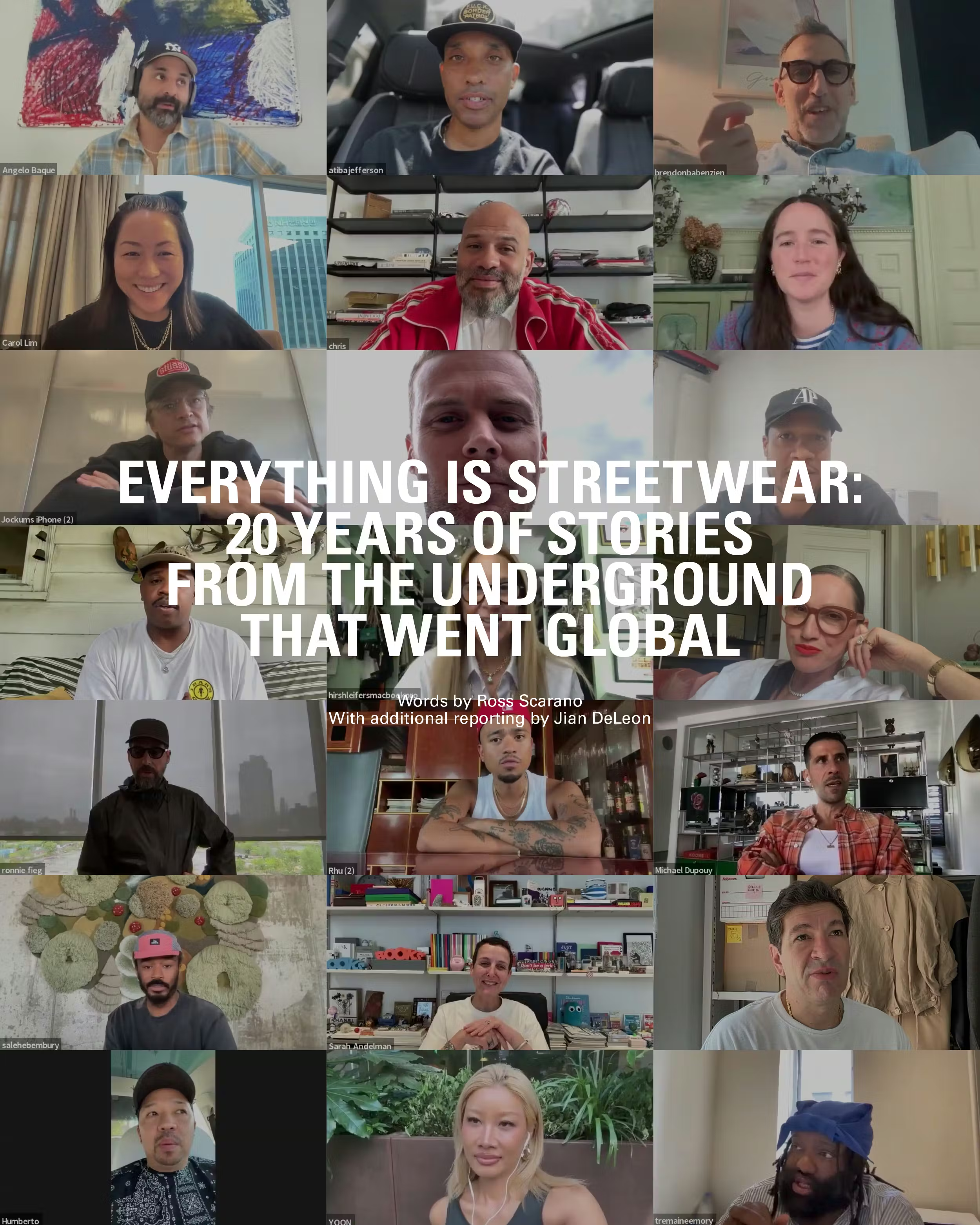
To celebrate the fact that Highsnobiety has been around for 20 years, we spoke with 20 designers, brand founders, store owners, and creatives who’ve played a role in the past two decades of personal style. The conversations — available in full on our YouTube page — create collage rather than a linear timeline. There are tangents unremarked upon and important figures left out. Because you’re probably reading this on your phone, feel free to Google anything that needs further context. Or try walking into a nearby store and starting a conversation about one of the moments or people mentioned here. Who knows what you might learn.
All quotes have been edited and condensed for clarity.


For decades, downtown New York has exerted a singular gravitational pull, attracting young iconoclasts, would-be artists, broke social mavens, and connoisseurs of what’s cool and exciting. Clothes, and how they are worn, are always a piece of this. Eventually, the codes and norms of whatever culture is produced south of 14th Street are broadcast more widely, where people who aren’t part of the scene can try to buy in. The gravity draws in the rest of the country. The rest of the world.
“Downtown was everyone’s new place,” Hettie Jones writes in How I Became Hettie Jones, her memoir of the scene circa the 1950s. In a previous era, adventurous bohemians took the A train uptown to experience Black culture, fomenting cultural exchange in the process. Jones’s downtown represented a moment of shared discovery.
Years after Jones and her interracial crew of poets, critics, and jazz musicians claimed the area, she encountered a store mannequin dressed like her. “It felt odd to have so prompted the culture,” she writes, “to have many other women want to seem to be you, whatever they thought you were.” Commerce is hungry for the authenticity of subculture, even if commerce is seldom good at understanding what makes a subculture worth living in the first place.
This cycle repeats. Twirl the dial forward 50 years, landing downtown circa 2005, and streetwear — though that word isn’t being used yet — is the catalyst for so much mixing and creating. Skateboarding and graffiti have replaced Beat poetry and jazz, but the mixing of races, ethnicities, classes; of Native New Yorkers and transplants; is an energizing constant.
Shops such as Union (established in 1989) and Supreme (1994) fulfilled the function of clubs and coffee shops, drawing the like-minded few. Not that these places extended an open invitation. New York in the 1990s was an aggressive place. Protective suspicion was the norm, though as this story will show, that prickly macho attitude eventually gave way to professional networking, lucrative collaborations, and rich veins of international corporate investment. What follows is one version of how that happened.
The ’90s were harsh like the month of January. People were cold; they were more hurtful. And then things loosened up [in the 2000s]. It felt like there were more opportunities and people were ready to have their minds expanded.
I was talking to a friend yesterday about 2005. I was in my second year working at Nom de Guerre. We had a shop on the corner of Bleecker and Broadway — a subterranean space with a secret sneaker shop in the back. Jude Law was one of my biggest customers, but I would never tell people. There was this kind of code.
In 2005, I was starting college. We’d buy shit on DigitalGravel. It really was just the local New York streetwear brands, so Rocksmith, 10.Deep, RockersNYC, aNYthing, STAPLE. There were these New York brands that I felt like I was supposed to wear.
You had the beginnings of shitty Tumblr fashion: all-over printed New Eras, 10.Deep, and Crooks & Castles.
I was in New York running production for different brands’ clothing lines. I was super into menswear. There was this amazing store my friends worked at on Mercer that sold Raf and Bernhard Willhelm and super experimental designers. Nom de Guerre was a formative place, too. I remember studying the runway shows, the street style, all the Japanese imported magazines. There was a bookstore on 12th called Gallagher’s, and I would go in there and just study fashion history.
I grew up skateboarding in San Francisco so I was really into skate brands like Stussy. The streetwear and street fashion I was being introduced to in San Francisco got elevated when I moved to New York. I was really inspired by rap music, Harlem and Cam’ron. I was wearing pink Polos, discovered APC and my style sort of morphed, became a bit more informed, but I was still searching.
Nom de Guerre was one of my favorite shops. Nort/Recon was another one. Alife Rivington Club. Clientele on Lafayette. Across the States there were other shops like Undefeated and Union [in Los Angeles]. RSVP Gallery [in Chicago]. Arrive in Miami.
Chris Gibbs worked at Union, whose emphasis on Japanese brands set it apart. As the years went by, the store only became more specialized. Eventually, Gibbs took over and doubled down on his enthusiasm for the craftsmanship that blew his mind when he first began traveling to Tokyo in the late ’90s.
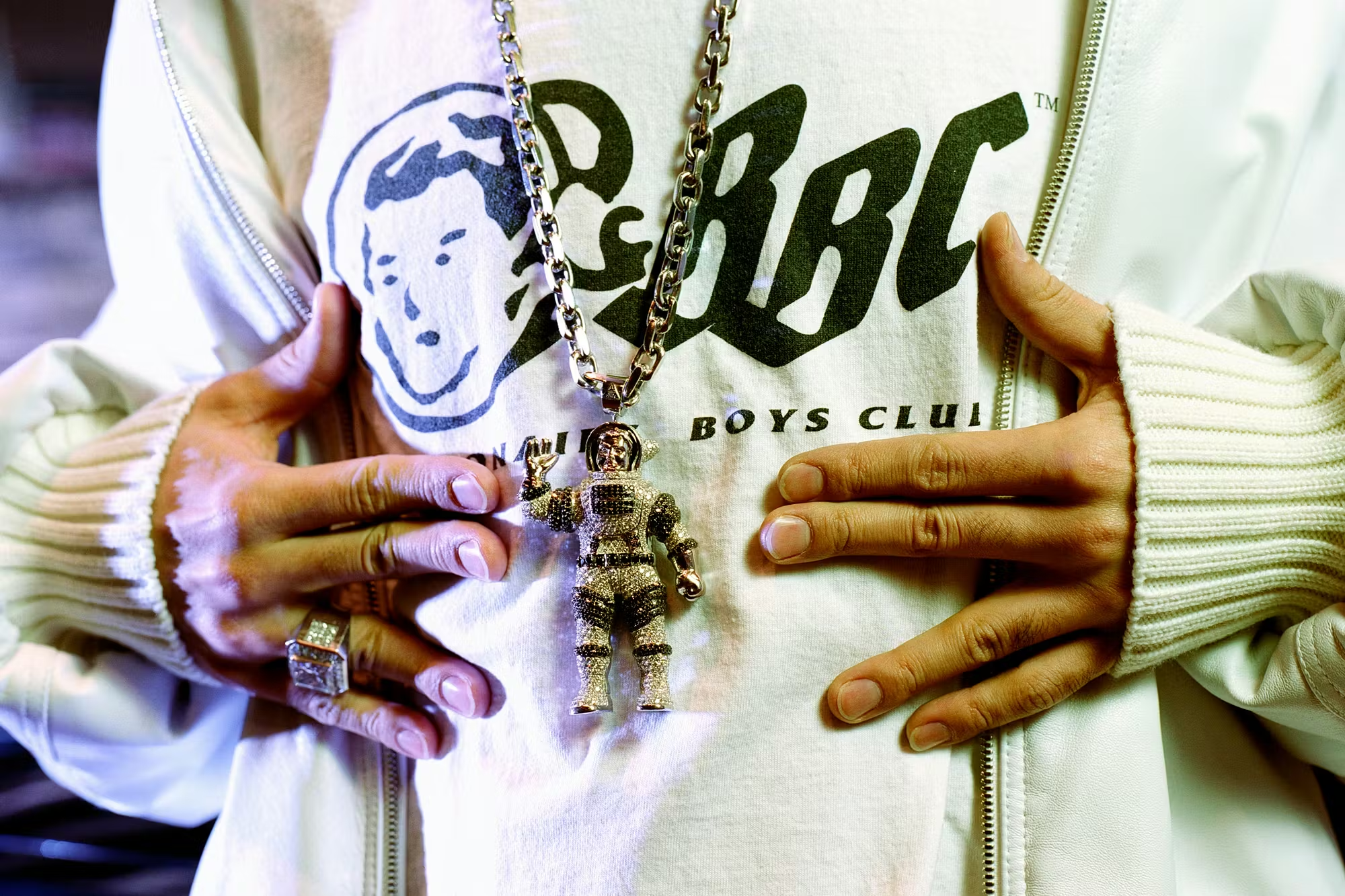
In 2005, buying Japanese meant buying BAPE. It was the anchor brand at Union that year — “with a fucking bullet,” as Gibbs put it. Toby Feltwell, a British skater turned A&R who moved to Tokyo in the 2000s, worked as an advisor to Nigo, the legendary creative visionary behind the brand. (He also worked with Nigo and Pharrell to launch Billionaire Boys Club.) At the time, the pair were planning to open the first US BAPE store. They focused on downtown New York.
There’s been nothing that we’ve had before or since that was as successful as Bathing Ape in that era. I’ve never ordered more of a brand from a dollar point of view than our orders with BAPE, and it would evaporate in a day. No social media, no e-comm, straight up brick and mortar. The first time I went to Japan for the BAPE buy, I remember looking at the line sheet. Most brands will give you minimums — if you’re not going to order at least 20 of this item, you can’t get it. My first Bathing Ape order there was a maximum, and I had never seen that. They were limiting how much you could buy. The BAPE hoodie, they make it in the green camo, purple, blue, red, and a multi-cam. And I remember reading that the maximum was one, and I’m trying to speak to a guy: “Sumimasen, do you mean one per color per size?” “No, one.” A.K.A., you want this hoodie? Pick a size and a color. That’s the genesis of why someone’s crying later on in line at Union.
Streetwear defines itself in a negative way, as in, “it’s not that.” You can’t just do anything; it has to follow certain rules, and defining the rules is part of the game. The contribution BAPE made to that space was in broadening the toolbox of things that were acceptable. You go from just varsity jackets and T-shirts, sweatshirts and hoodies, and maybe a pair of jeans and some combat pants to adding more and more things that can fit into something that feels like it’s still real. It hasn’t jumped into the, “OK, we’re doing fashion now” zone.
Codes and rules, even unspoken ones, are necessary for any coherent underground, whether in New York, Tokyo, or Stockholm. Jockum Hallin cofounded Our Legacy in the latter city in 2005, expressing a personal style formed in the crucible of multiple overlapping subcultures in the form of a cult menswear brand.
Coming from skateboarding [and other] subcultural things, hardcore and sneaker culture, [influenced my style]. But also growing up working in fashion stores, so I had that devil talking to me on the other shoulder. It was a Chuck or a Van on the feet; straight Chinos, cropped; maybe a vintage Ralph shirt; an old Burberry trench or a vintage M65. Maybe there’s some Margiela, some Helmut, whatever I could afford back then. [In Stockholm] it was more inspo taken from smaller brands, lots of stuff coming from the UK, coming from New York, some Japanese stuff.
The energy, or the identity for [BAPE], was all coming from New York at the time. Nigo and I would be there once a month. It was scenes of stereotypical excess: lots of silly parties and jewelry and champagne and private jets and et cetera, et cetera, which was hysterically funny. The image of the brand now is pretty much what was formed those 20 years ago.


By the end of the 2000s, aspiring creatives such as the sneaker designer Salehe Bembury had moved from adolescence into adulthood and, tragically, into the workforce. (For many resellers of clothes and sneakers, being in the office meant squatting with a portable DVD player and snacks on the sidewalk outside Lafayette Street in New York, or outside Colette, the widely adored Parisian concept store that Sarah Andelman co-founded with her mother in 1997.) In Bembury’s case, his employable 20s meant a job at Cole Haan, where he was nervous about how to dress for staid cubicle life: how much ankle does one show in their jeans and wingtips?
Under the guidance of CEO Mickey Drexler and the fastidious creative vision of Jenna Lyons, J.Crew rebranded itself to prominence by addressing those precise concerns. With the co-sign of the Obama family, the brand and its snappy version of American heritage was big business; in 2010, J.Crew received a newsworthy $3 billion buyout offer. Tradition was back, much to the grumbling of folks such as Feltwell, who believe in the new rather than any retrenchment of the old. (If you want to see Toby Feltwell get a sour look, just say, “waxed mustaches.”)
That was my third job out of college. I was working for Jeff Henderson, this Yoda from Nike. He was the design director on the Lunargrand project. You have this shoe that successfully found the respect of a professional hard-bottom Oxford and the comfort and functionality of a sneaker. I was wearing button-downs, I had my jeans — I was showing ankle — and I was wearing the Lunargrands.
We had a massive women’s business, and so we wanted to focus on the men’s department. Andy Spade had a company called Partners & Spade with Anthony Sperduti, and we asked them to help us kickstart the men’s business. They had the idea of taking over this liquor store in Tribeca. The woman [who owned it] had let the lease lapse, and a synagogue had opened in close enough range that you could no longer serve alcohol there. The woman refused to remove the bar so it rendered this space unusable. We did a much more edited selection than you could in a large store, and we were starting to do collaborations at that point, so this was a way to highlight them. [The J.Crew Liquor Store was] a more edited and refined viewpoint on what we loved and wanted to share.
I would credit J.Crew for pushing the American man forward. I would credit them with the fact that guys even know what selvedge is. During the Jenna and Frank era it seemed like they really understood what was happening elsewhere. They started bringing in a little bit cooler sneakers and all that third-party brand stuff. James [Jebbia] and I looked at it like, “Oh, these guys are doing a pretty good job of giving the average guy options.”
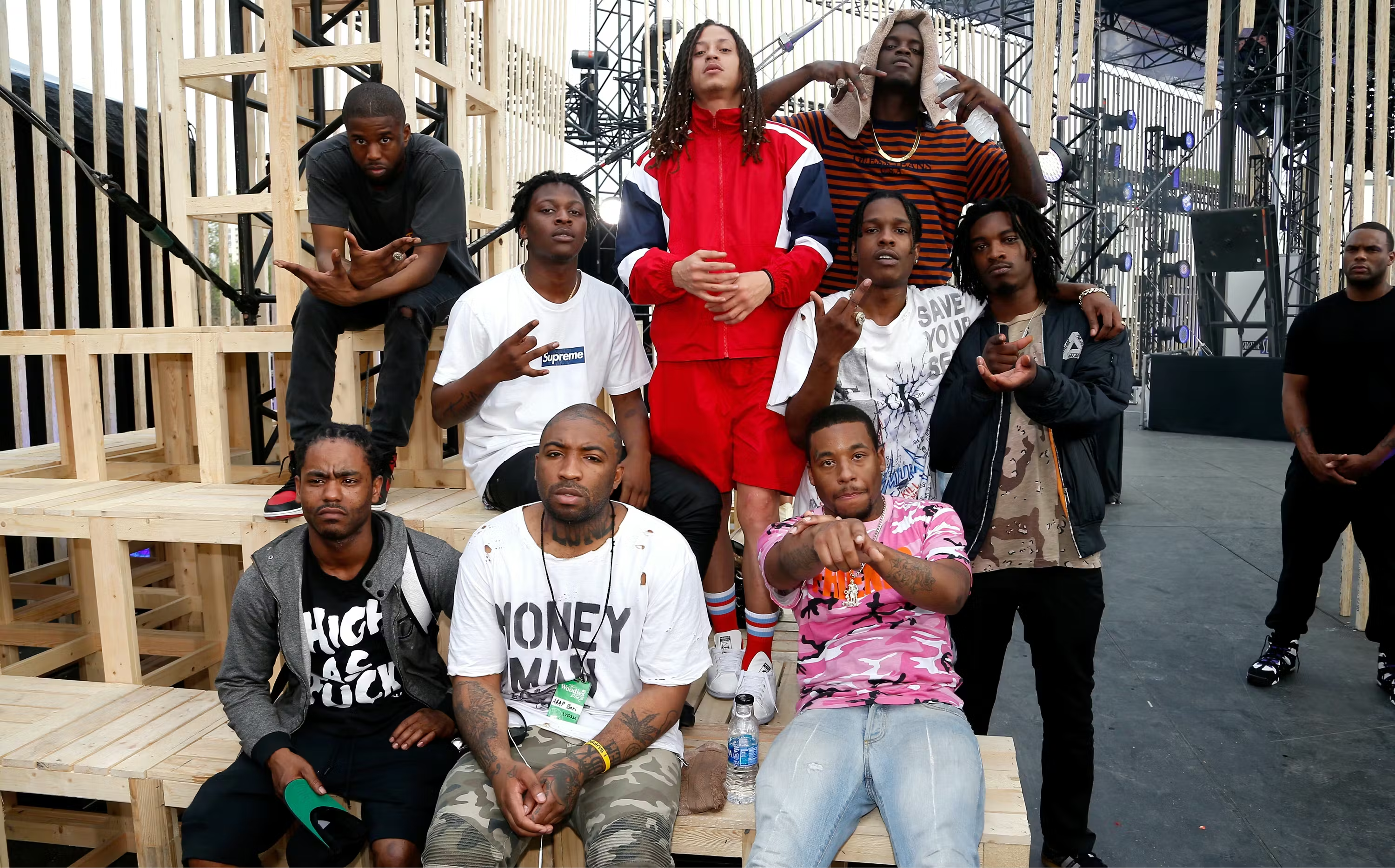
An alternative to the 9-to-5 grind arrived in the form of a 19-year-old Angeleno who would declaim things like, “kill people, burn shit, fuck school.” In his first late-night TV appearance, Tyler, The Creator, leader of Odd Future, stood before the cameras in 30 Rockefeller Center in a white hoodie bearing a red rectangle that read “Supreme.” An entire generation of acolytes was born that night in February 2011 on Late Night With Jimmy Fallon. (Or, more likely, on YouTube the next day.) Tyler ascribed to the outsider ethos that Feltwell used to describe streetwear — “you don’t fucking skate, take off that box logo,” as he put it on his early classic “AssMilk” — but plenty of the kids who now wanted Supreme would never so much as attempt a kickflip in the long driveways of their well-appointed suburban homes.
We would have our annual [family] cookouts, and let’s say from 2011 to 2012 there was that shift. It went from nobody gave a fuck about what I did for a living, and now my little cousins were like, “Can you hook me up with a Supreme hat?” ASAP Mob, Tyler, Earl, Terry Richardson — all these things were happening all at once, and Supreme was at the center.
Supreme been around since ’94. What really made it blow was a mix of great designs by Supreme, Instagram, A$AP Mob, and Golf Wang. You got a new West Coast crew that’s galvanized the youth, the East Coast crew that’s galvanized the youth, you got Instagram, and then you’ve got great clothing and design by Supreme, and that created how it blew up. And the same goes for Skepta, BBK, Giggs, Wales Bonner, Martine Rose — all these people have been doing it for years, years and years.
The recession created the opportunity for Chris Gibbs to buy Union from its owner and founder, Eddie Cruz, and implement a new business plan: He would no longer engage in the sale of a central streetwear object, the T-shirt. He wanted to invest in expensive pieces, and he had his eyes on a Japanese brand better known for its moccasins than any logo tee.
For a good 10 years, my career was singularly tethered to Visvim. It was a brand I loved and understood. I had a really good relationship with Hiroki [Nakamura], and from 2010 to 2017, maybe 2018, around 50% of our revenue was Visvim in particular. We were doing two trunk shows a year where Hiroki would come to town, we’d rent out the Chateau Marmont, we’d do a whole thing. We had a bunch of big-ticket buyers like John Mayer, for example. No one that was really famous because the trunk shows are a pre-book, and when you’re rich and famous you don’t want to buy something and wait six months for it. It was mainly well-off gentlemen with taste. Some people were upwards of $20,000 a season on Visvim.
Celebrating a decade in business in 2012, Humberto Leon and Carol Lim threw a massive party at the East Village music venue Webster Hall for the birthday of their store and brand Opening Ceremony. Inspired by a trip to Hong Kong the two founders took, Opening Ceremony embraced a global future for fashion, not as a rebuke to any sort of downtown provincialism but simply because it reflected their taste. And buyers from stores around the world came to study Leon and Lim’s taste.
In the early 2000s, Carol and I were discovering these young brands; we were the first store for Acne, Alexander Wang, Band of Outsiders, Rodarte. By the 2010s, I think a lot of these brands became big. We would carry Jacquemus and then within three seasons Jacquemus became big. We would carry JW Anderson and then two seasons later he became big. Carol and I would sit through the graduation shows, and we would pluck the five designers we were obsessed with, and a lot of times they didn’t even have money to pay for a collection. So we would fund their sampling and production and size runs.
E-commerce became more of a mass way of shopping, too. By the 2010s, people wanted next-day delivery. That coupled with the globalization for mass brands.
In 2010, Tremaine Emory moved to London to work for Marc Jacobs, where he fell in with the wave of grime powered by Skepta, Giggs, and others. A music fanatic at heart, he thought about the influence of the United Kingdom through the lens of the British Invasion and punk rock.
You could say streetwear was started by Vivienne Westwood: World’s End, SEX shop, Seditionaries, her and Malcolm McLaren. You know, Hiroshi [Fujiwara] came to London and was hanging out at that shop, following Barnzley [Armitage] around. Then, fast forward to Wales Bonner: she went to [Central Saint Martins]. I went to her first presentations; I’ve known Grace a long time. Definitely one of my inspirations for the way I make stuff: Wales Bonner and Martine Rose, those two incredible women. But these women have been doing it a long time. And the world’s just catching up. All those things that have popped off in London, the world was late.


As the decade wound down, the boundaries between streetwear and high fashion became increasingly porous. No designer would better embody this insouciant collapse of cordoned-off spaces like Virgil Abloh. The multi-hyphenate designation is a bit of a cliché now, but the restless, globe-trotting Abloh earned it as a DJ, graf writer, creative director, designer, brand founder, architecture instructor, furniture designer, and professional networker (even though he caught jokes from time to time). Anyone who crossed his path will tell you how kind and optimistic he was. Not everyone totally bought in, but that hardly mattered — he made it happen anyway.
[Virgil] had so much enthusiasm. I saw myself in him in that way. He was such a nerd in a good way, and he could translate what he saw for a different audience.
I met Virgil on Splay I think. It was a discussion board, like Twitter before Twitter. It was invite-only, and a lot of kids from Supreme and downtown New York were invited just to talk shit. Black background, white text, red links — that was it. I was working as a runner at La Esquina, the Mexican place on Kenmare. Virgil walks past me one day and we do double takes and I'm like, “Virgil?” He's like, “Heron?” We dap each other up, and the rest is history. Through him I met Matt [Williams], I met Justin [Saunders]. And that friendship is how Been Trill was created.
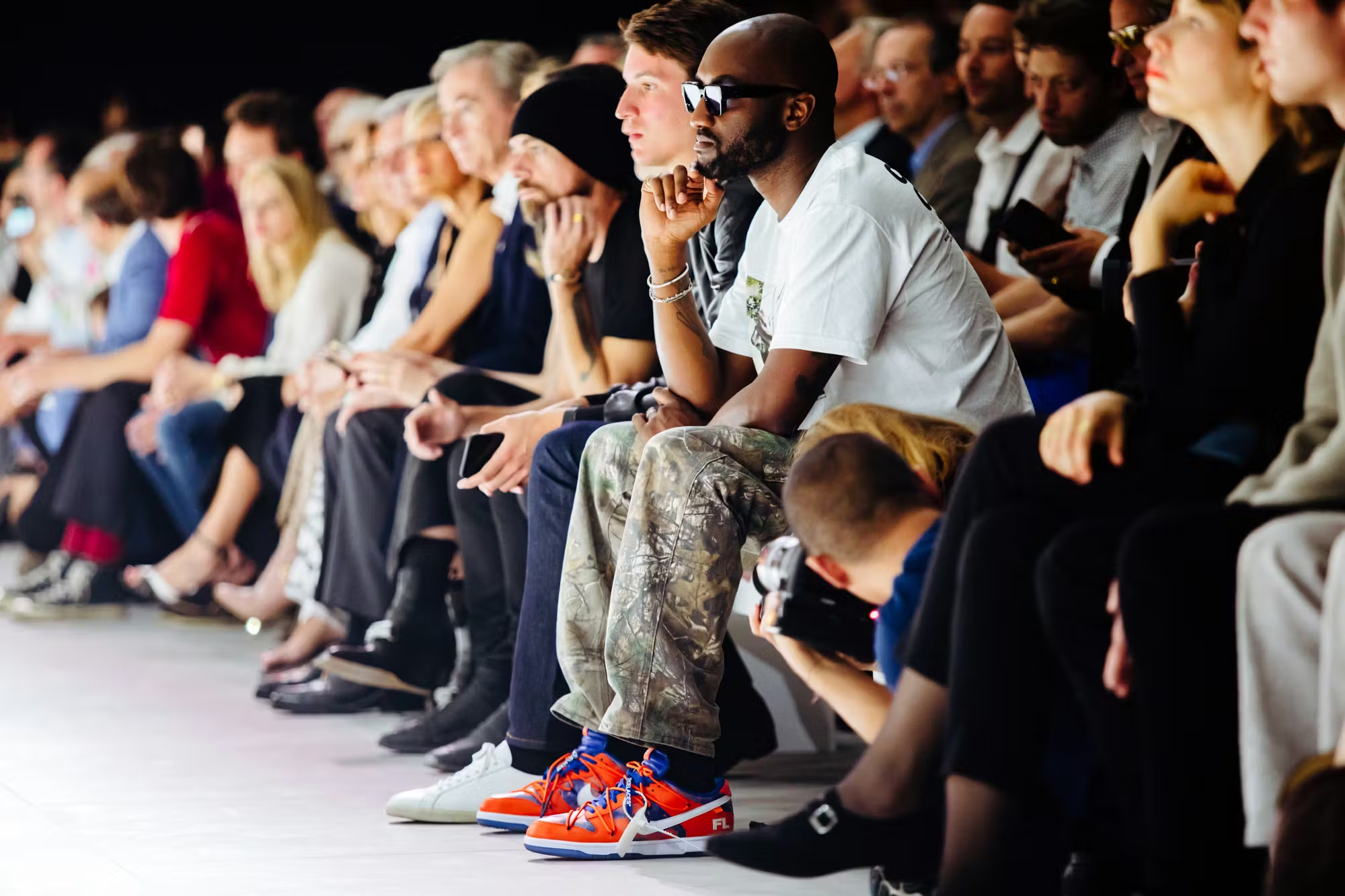
Virgil landed in LA and I picked him up at the airport. He was always the passenger DJ because he was always getting music really early. And he was like, “Matt, this is what’s going on in Chicago.” And he played Chief Keef for me. That music marks that time.
I always describe it as a boy band. We would make our own uniforms, and those would be graphic tees. Every time we showed up to DJ, kids wanted to buy them. So we started making hats and tees, and that became a brand.
Virgil and I met via email for the launch of the Pyrex T-shirt; we did it at the water bar at Colette’s restaurant during fashion week. I was surprised that so many cool kids knew about him already. There were not a million sources of information like now — the precious years just before Instagram. At the beginning it was T-shirts, and I remember I could not understand why he wanted to do something more sophisticated with fashion shows. There are already so many brands — are you sure you want to go into this world? But for Virgil, very very early it made sense. There was this transition where first I would go to the showroom and it was just T-shirts — and suddenly there were jackets and pants and this and that. But there was this moment where I was like, “Are you sure?”
Virgil came to the store a bunch of times. After he did Pyrex, he started Off-White and showed us the collection in this little space somewhere on the Left Bank — that was the first time we met him. It was completely different. It was a tiny room and everything was done by color: white, red, black. Everything had the Off-White logo, and it was really a strong moment. There was no question that it was going to be something very important. And then Hirshleifers did a collab with Off-White when we did “The Bedroom” — he came to the store for that. He was unbelievable. The warmest, sweetest, man. We all miss him.
Virgil was one of the most important people I could relate to just in terms of bandwidth. There was this four-hour text thread where we were both on flights just texting each other PDFs of what we were doing. And when I opened World of Niche — this little footwear shop nobody knows I owned — there was this eight-hour session in my old office and neither of us got up to use the bathroom and neither of us ate. We were just talking about plans. He was such a great idea guy. Probably one of the most creative people I've ever met in my life.
The news of March 2018 shocked the fashion world: Virgil Abhloh would be moving his family to Paris for his new job as artistic director of menswear at Louis Vuitton. He was 37.
To make it dramatic, it’s like seeing Obama become president. I was like, “Holy shit, I don’t want to be president, but now it seems like a possibility.” With Virgil it was like, oh my god, it’s someone who looks like me in a high-fashion space. In every movie I’ve ever seen where there’s a man flying first class and doing that whole life, he’s a white guy wearing a suit. To see Virgil take a business-class flight wearing a hoodie and untied dunks and then get off the flight and there’s an old white man holding his name on a fucking piece of paper, and then he grabs his bags — that was an education: whoa, this is possible. And it never felt like showing off. They say, “Hold the door open” — that motherfucker was just holding the door open and being like, “This is the life. You can have this.”
Following in Abloh’s footsteps, Bembury became the head sneaker designer at Versace, shaking up the Italian fashion house with his shoe, Chain Reaction. Bembury recalled that in meetings in Milan, Donatella Versace might wear a “gown,” the CEO would be in a three-piece suit, and Bembury, true to his own taste and emboldened by Abloh’s example, was in a tie-dye shirt and pants from Supreme.
As for Supreme, the year before Abloh’s historic appointment, LVMH extended a hand in the form of an official collaboration with its flagship brand. Brought to life by creative director of menswear Kim Jones, the collab came down the runway at the Palais Royal, although real heads will recall that almost two decades prior, in 2000, Vuitton issued a cease-and-desist order when a Supreme deck used the LV monogram.
Did Colette, which created a shoe with LV in 2015, pave the way for Supreme?
I don’t want to give us more importance…but yes, for sure. I think we helped people realize the same hip-hop artist would wear Supreme and the Vuitton bag, and why not bring them together?
Sarah was the most open-minded individual I met during my entire life. She can have strong opinions about high fashion, music, food, design, street culture, sneakers, stilettos. She’s open to debate, and you will learn a lot from her. She had the possibility to do exactly what she wanted to do in that store, and she had zero limit. That’s why on the same day at Colette you will have the possibility to meet Drake, Karl Lagerfeld, a young designer coming from Japan, I don’t know, a foodie.
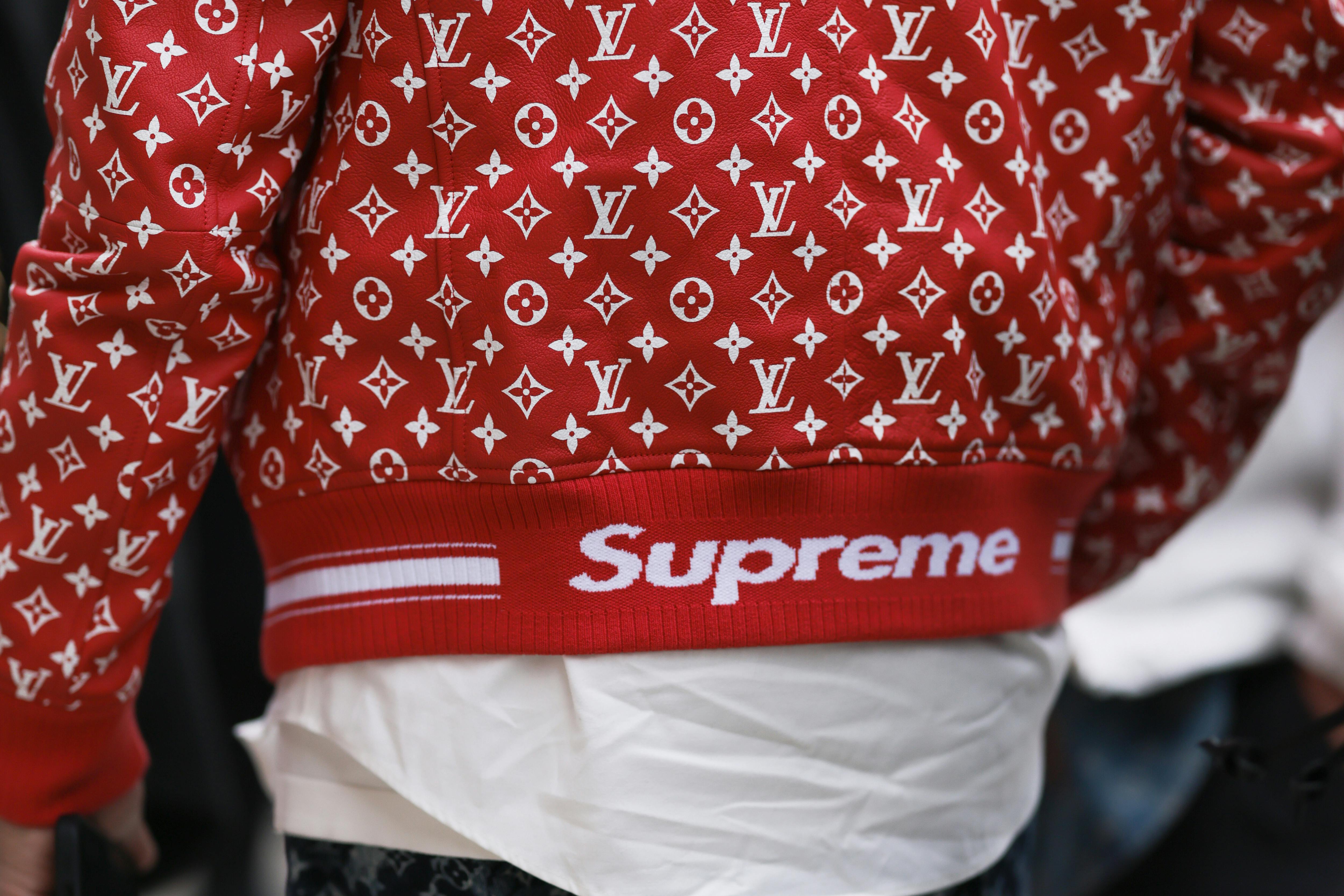
You could think of that as being the end of the path for the version of streetwear we were involved with. Because if that’s now Vuitton, what does it mean anymore? When you go from a self-made bunch of friends doing what they think is cool with no real external support to having something officially sanctioned by the most dusty, venerable part of the luxury world, it’s drawing a curtain over something.
For me, graffiti and streetwear are one and the same because streetwear comes from skateboarding, and graffiti writers and skateboarders are the same type of person. Those underground worlds were juicy for the picking. What a gift for the fashion world to have streetwear to explore.
Supreme to me is always going to be a skate shop. HUF is always going to be a skate company. We know what streetwear is: a company that’s down and dirty and from the streets. High fashion can’t claim the streets because it’s not. That’s why skateboarding stays fresh: because we’re in the gutter. We’re street.
After leaving Vuitton, Kim Jones took the helm at Dior. One of his hires was Yoon Ahn, who he brought to lead Dior Men’s jewelry program. For her, the cross-pollination between streetwear and luxury recalled her Tokyo roots.
It’s fun to witness on the stage of European fashion, but I mean, coming from Tokyo, these were nothing new. We were so good at mixing high and low: Supreme with Vuitton or Dior. But it was refreshing to see on the catwalk and world stage. It was a reminder that that’s what consumers really wanted; they were just answering it.
Back in New York, new brands were coming into their own, rethinking the codes of American style and trying to dress a new generation that had perhaps dabbled in streetwear and the J.Crew boom and now wanted more tasteful, bespoke offerings. They gravitated to BODE, the brand founded in 2016 by Emily Adams Bode Aujla, an Atlanta transplant with an eye for pastoral serenity, lived-in fabrics, and East Coast mythology.
In fall 2019, I did a collection on a friend of mine, Todd Alden, and we talked a lot about his childhood and how we were both shaped by this idea of collecting ephemera. He talked about collecting pennies and putting them in these little plastic sleeves, and I ended up designing a jacket that had pennies encased in plastic. That garment really spoke to my entire philosophy around why I do what I do and why memories are so important to the way I design.


Retail apocalypse. Post-COVID. Vibe shift. Quiet luxury. Boom boom. Recession indicators. The latest chapter in fashion resists easy encapsulation, like trying to catch a breeze. Speed and information are givens, but is any of the information good? And what use is the tempo if it doesn’t allow for meaning?
These days, creative directors and designers cycle through houses and brands with almost comic quickness. The past five years saw tragedy, too, with the shocking death of Abloh in 2021. Two years later, Pharrell Williams took over at Louis Vuitton. Tyler, The Creator collaborated with LV in 2024; in one of the ads, he’s standing in front of a bi-plane, holding luggage. Tradition rears its head again, albeit remixed.
Almost to a person, the participants in this story are talkers; They know how to move in a room full of strangers and how to connect over a shared interest. They spot talent and build relationships. Where are these skills in 2025? As Angelo Baque described it, his nightmare is riding the subway in New York City and “everybody has their heads bowing down into their phones, and nobody’s looking at or talking to each other. That’s fucked.”
Perhaps it’s hard to talk about the past five years because it’s still unclear what they’ve teed up. But we can make certain educated guesses.
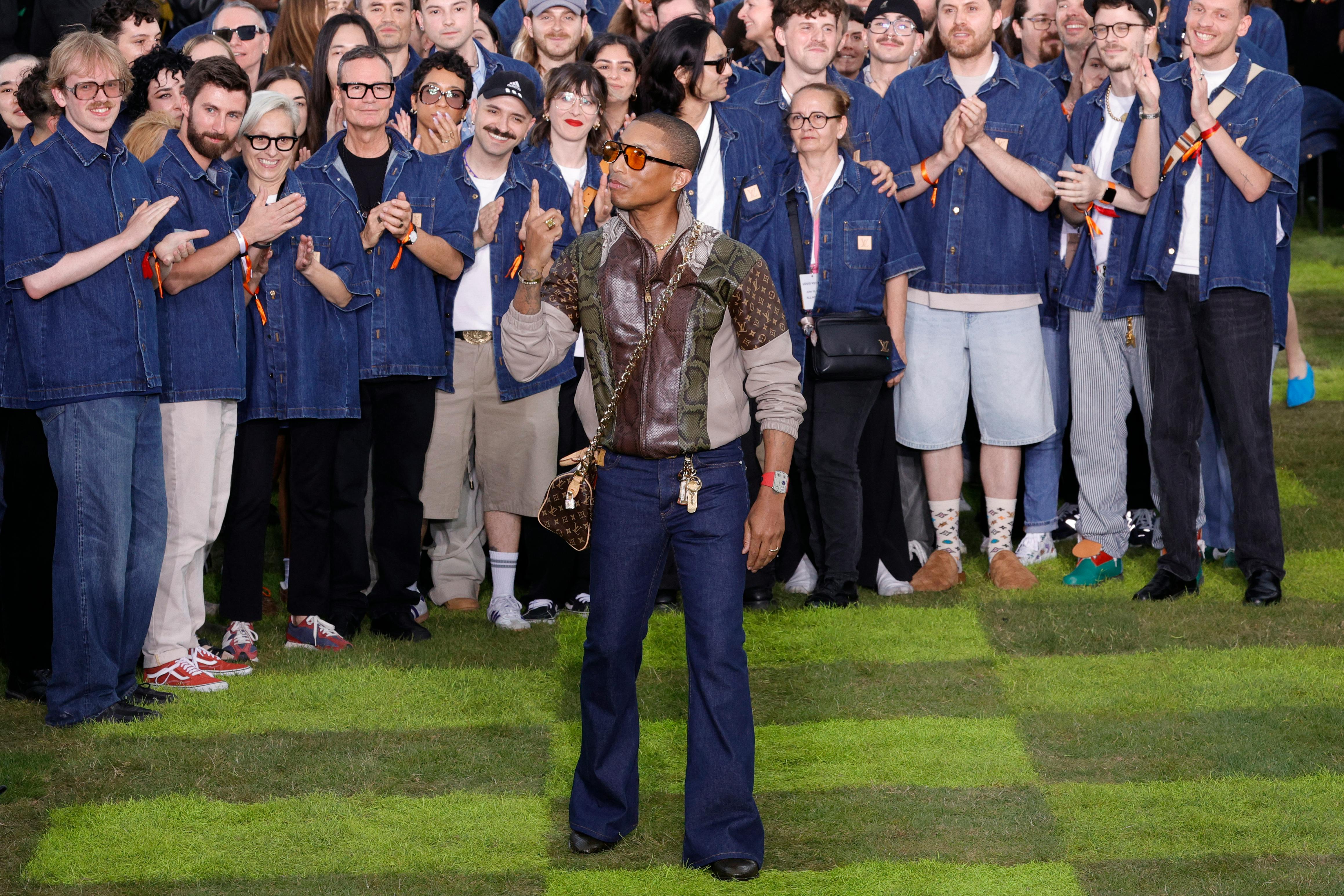
I think the main killer for a lot of companies is production. At the end of the day it’s a business, and you have to have your accounting and your margins correct. Otherwise, you’re living in a dream. There’s a way to either alienate your core customers or bring them on a journey, and right now we’re still in the trial-and-error stages. Just like how musicians have their core fans, there are fans of the brand who believe in our very first album more than where we are now. So we’ve got to figure out how to capture the essence of that first album. And it’s a difficult ride.
Bode has always been about history and intentionality, but growth also requires efficiency, and we’ve worked to build a structure that supports both. Every piece begins with a story, one that is deeply researched or personally resonant, so it’s important to me to continue telling these stories with the same level of care. I believe you can build a business that supports what you care about, the process just needs to shift as you grow.
The idea most kids have is just like, yo, you start a T-shirt brand and then you’re raking in money within a year. If that happens for you, great, kudos. But for the most part you’re just building. A lot of people don’t realize before you get to that 2010 moment for Supreme, we’re talking about 20 years of really busting your ass. And that doesn’t happen for everyone. You think of someone like Marc Jacobs, I think he fell three or four times before hitting in the mid-to-late ’90s. There’s so many designers out there that it took one, two, three, four, five times before it actually came together.
There’s a myth that people are more independent in their thinking. I don’t believe they are.They’re given more room to roam, sure, but they’re still being fed a lot of information about who to be and how to be and what to wear. You see more people trying more things, but I don’t know if it’s as authentic. Back in the day, you were relying on the store owner or the buyer, their ability to curate something you might be interested in, and you trusted it. So you might see something on a rack, a brand you had never heard of, but you touch it, you’re like, “Oh, this feels good, this looks good,” and buy it. I feel like even if you wanted that level of independence as a consumer, you might not get it because you’re going to hear about everything, whether you want to or not.
With Denim Tears, the store is doing well. But we still do better online in New York, and for me it’s kind of bugged out. You live in Brooklyn, so get on a train, come to the store, meet the staff and try on the clothing and see the other stuff we make, you know what I mean?
I did a show in Hong Kong at Christmas, and we did a project with the artist Kasing Lung who did the Labubu. And now every day I see the Labubu. It’s everywhere — the fake one, the real one. It’s terrible because originally I loved it. It’s like matcha. I used to like matcha, but now it’s everywhere. So I’m like, “No, it’s ridiculous, I cannot have a matcha.” This kind of amplification goes so fast to the point you are disgusted by what you used to like.
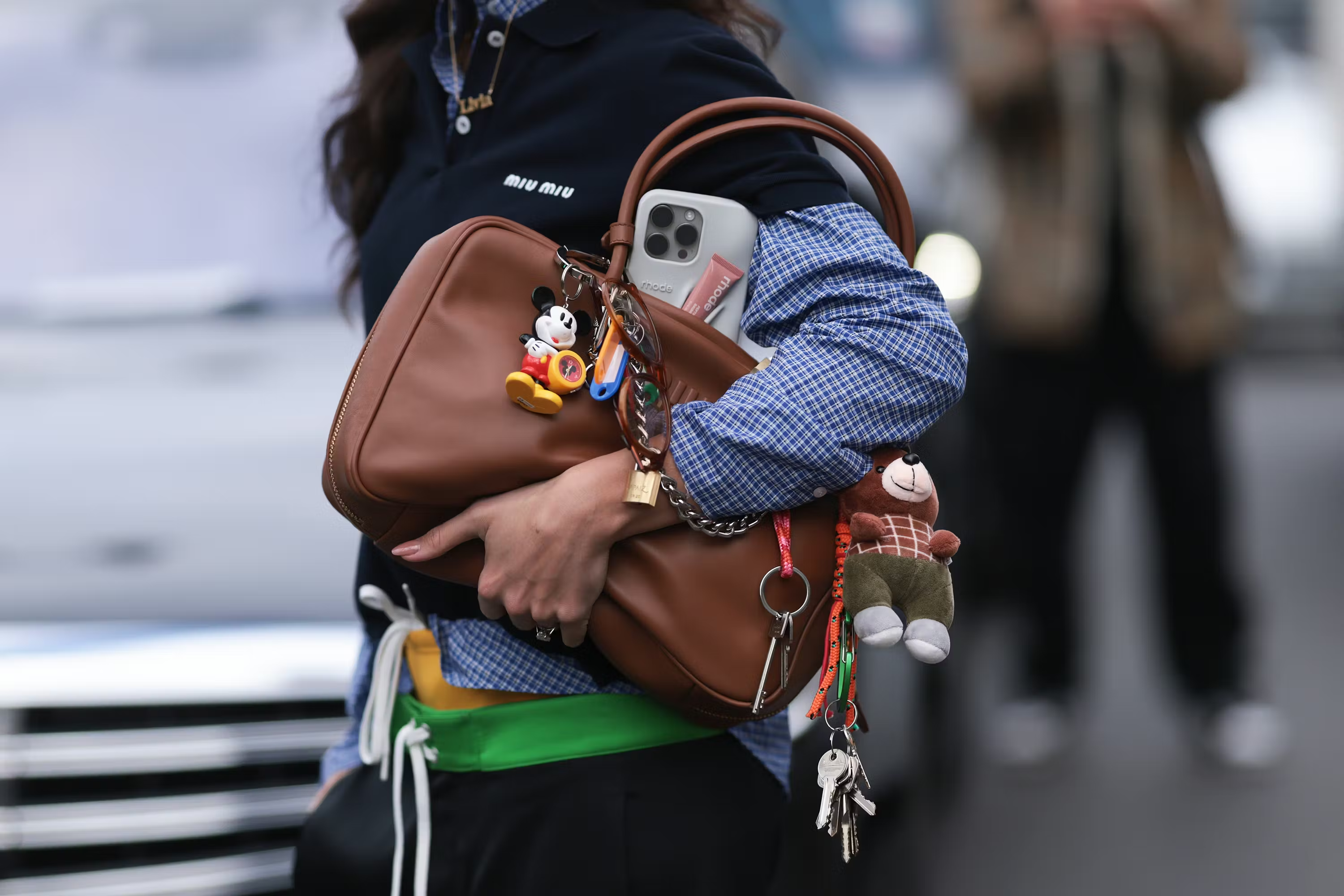
There’s this Black Flag flyer [Raymond] Pettibon did talking about the punk or hardcore scene in LA, and it was like, “Stop complaining about the scene. Go start a band, throw a party.” That’s what Been Trill was. And that’s why I'm starting my brand now. Let’s stop complaining about how broken the system is and just make great product with great value for the community. Let’s give value in a world so often lacking it rather than presenting a business plan that nobody sees come to fruition. The easiest fix is to change that designer, fire that CEO, blah, blah, blah. Change is the easiest way to fix a complex problem rather than spending the time and energy to understand its nuances.
Some fashion thing that became corny — pick one in your head, something that used to be cool that’s big now. That thing was cool for a reason. It stood on its own legs to people who really knew what was up for a reason. So it'll come back. Don’t worry that every kid and their mother has one; it’ll come back because it’s dope. These people who are like, “Oh, New York is dead after the pandemic.” Give things time.
Hopefully I can live to be old and corny one day. The older you get, the more you realize it is not about being the biggest, best thing forever. And then you start to embrace the cycle. Things will be fine.
Credits
Words By: Ross Scarano
With additional reporting by: Jian DeLeon
Videos By: Peter Sidlauskas